Tuesday, March 15, 2011

Oh, Venezuela!

My favorite quote from this article in the New York Times today:
“I’ve never seen more silicone anywhere else,” Mireia Sallarès, a filmmaker from Spain who focuses on feminist issues and is working on a project about Venezuela, told the newspaper Tal Cual

I can't imagine.

Friday, February 18, 2011

Rain, rain go away

Ugh, this rainy, cold weather is really getting me down.  Being cooped up inside with windows full of dreary grayness is no fun.

After we moved down the Peninsula (and then even further to the South Bay), my husband often claimed that he missed the misty coolness of living in the Outer Sunset.  I was happy to claim a new Bay Area microclimate... but where's that Northern California sun now?

Tuesday, February 1, 2011

"Bargain plastic surgery". . .

. . . three words that shouldn't be seen together.

Dr. Weintraub forwarded me this article, and I continue to be equally fascinated and horrified not only by what some medical "professionals" out there continue to do, but also by the poor men and women who are susceptible to such fancy phrases and rock bottom price promises.

As a Bay Area plastic surgeon, I want to believe that our community is too well-educated and informed to fall prey to such things, right?

Saturday, January 29, 2011

Why, hello again.

Wow, has it been a while.  2010 disappeared in a hurry, leaving me grasping at the beginnings of 2011.  So let's give this another try.

A few plastic surgery-ish things in the news lately (although lately is probably being overly generous):

Thursday, January 27, 2011

Regarding the FDA's recent breast implant news

The headlines sound alarming; anything with "breast implants" and "cancer" in the same line certainly catches my attention.  Anaplastic large cell lymphoma (ALCL) may have a possible association with breast implants.

But if you read the FDA communication, you learn that although there is cause for heightened awareness regarding this unusual cancer, thankfully, it seems to be relatively rare.  ALCL has been formally reported in 34 of the approximately 5-10 million women worldwide who have had breast implants.

Relatively rare, of course, is meaningless, if it's you; thus the recommendations for monitoring your breast and implant health with self exams, mammograms, and MRI (if you have silicone gel-filled implants).

Wednesday, August 25, 2010

The Best of Silicon Valley

Go Duet! Thank you to everyone who nominated us for the "Best Plastic Surgeon in Silicon Valley 2010" - what an honor.

Vote for us here!

Friday, August 13, 2010

Bab(i)es, Botox, Brouhaha

Probably too young for Botox... Photo courtesy of Maggie Smith

We saw last month the first inkling of the young Glee star admitting to using Botox, now fleshed out into a broader story in this week's NY Times article. Does this represent the early days of a growing trend: cosmetic procedures and surgeries for teenagers becoming commonplace? I think it's interesting how casually some folks are reacting to the news, even comparing it to teens who wish for and receive rhinoplasty (and that's a whole other can of worms...).

And over here, the actress Teri Hatcher (of Lois and Clark and Desperate Housewives television fame) apparently tired of the criticism that she had too much Botox and plastic surgery, posted photos of herself grimacing delightfully in her bathroom mirror.

Botox: it's not for everyone.

Thursday, August 12, 2010

News, news

Like I've admitted previously, I am entranced by news/stories/articles/books about beauty and its perception. This series of special pieces in Newsweek about that exactly makes for some fascinating reading.

Thursday, July 22, 2010

It's not just the ugly Americans

A flurry of plastic surgery and beauty-related news from foreign lands lately:

Is Taiwan Asia's next one-stop plastic surgery shop?
Who knew? I just visit for the food...

Indian students flock to plastic surgery to get ahead
. I think this happens here in the US as well, but people tend not to be so frank about it (and we're not just talking about the citizens of Hollywood, either).

Vaseline skin-lightening app stirs debate. Now this isn't a new phenomenon in Asia; many East Asian women are quite fastidious about sun avoidance and a number of creams/lotions/potions/treatments promise to lighten or brighten are directly marketed at them. But the app seemed to take it one step too far.

Wednesday, July 21, 2010

Plastic surgery bits and pieces: roundup

Wow - just when I was starting to get worried that celebrities had given up on plastic surgery...

Experts: Lindsay Lohan Got Filler in Her Lips Before Jail. Not exactly a peer-reviewed journal, but fascinating nonetheless. Was it Restylane? Or Juvederm? The world holds its breath...

Teenage singer Charice gets Botox for 'Glee' debut. I admit, I really have no idea who this young Filipina is (am I showing my age?), but I hear that Glee is quite a popular show. I understand one wants to make a good impression, but why did this beautiful 18 year old think she needed Botox???

Vampire facelifts: Cosmetic surgery's crazy new trend. Ditto for the whole Twilight phenomenon. But the plastic surgeon's responses in this Salon interview are pretty entertaining.

Don't rule out plastic surgeons yet
. That's right. No dinosaurs here.

And finally, I leave you with this heartwarming story that has nothing to do with plastic surgery (but yes, there is still some surgery involved).

Thursday, July 15, 2010

News bits and pieces in the plastic surgery world

Not too much going on out there, save for the usual celebrity plastic surgery speculations and denials. Maybe everyone's on summer holiday.

Cosmetic surgery, Hollywood style. From the LA Times online, putting the blame on TV/mass media for the current plastic surgery "craze". Make of it what you will.

12 ridiculous plastic surgeries. A rather entertaining slideshow of "crazy" plastic surgery-type procedures. There are some valid procedures in the mix here; I'll leave it up to you to figure out which ones. And over here, some snarky OC commentary.

The new face of surgery. Not everything in plastic surgery is nip/tuck. This sounds like a great development for victims of facial trauma everywhere.

Frenchwomen's secrets to aging well and 10 ways to age like a Frenchwoman. My favorite bit from this NY Times Style section article is the quote from a Paris plastic surgeon: the point of plastic surgery in France is “to keep the natural beauty and charm of each individual woman, not to fit some current ideal of beauty.” My thoughts exactly - and that's how Dr. Weintraub and I approach every patient at Duet Plastic Surgery.

Friday, July 9, 2010

Friday Figure Fix: Next installment, coming up

Never fear, Friday Figure Fix will be here... Give me a little time to work on the next "boob"-related topic. I think what we'll tackle next is the challenge of making breasts that are too big (headaches, neck strain, back pain, shoulder grooving, social discomfort) more manageable.

Friday, July 2, 2010

Friday Figure Fix: Making them bigger, part 3

This week's Friday Figure Fix wraps up "Breast Augs 101" for all you rabid MPL fans out there. We covered some common questions, the technical aspects (and more), and today we'll discuss some of the complications of breast augmentation. With this kind of surgery, in a skilled plastic surgeon's hands, complications are fortunately uncommon; but they do happen. This week's post is not necessarily to scare anyone off, but to be realistic, provide you with as balanced a picture as possible, and help you become a better informed consumer.

To begin with, breast augmentation (as I keep harping) is still surgery, so all the common risks inherent to surgery apply: bleeding, infection, scarring, need for revision, etc. Some of these standard surgical risks do merit a deeper discussion in the case of breast implants.

Bleeding. We'll include hematomas and seromas in this part of the discussion. But first, some bleeding is expected; we are talking about putting surgical steel to the skin and parts beneath, right? Surgeons, and especially plastic surgeons, have a love/hate relationship with bleeding. On the one hand, bleeding is good - it reassures you that the tissue you're working with is alive; on the other hand, bleeding is bad - blood belongs on the inside, not where you're working...

Anyhow, when we're dealing with breast implant surgery, the rate of bleeding complications is fairly low; we're generally working in an easily identifiable layer where a lot of pesky blood vessels are not typically encountered. So hematomas (collections of fresh or clotted blood) and seromas (collections of clear fluid created by the body) do happen after breast augmentations, but rarely. A few surgeons place drains (tubes to help evacuate fluid from the body) to prevent hematomas and seromas from developing after breast augmentations, but most (including us at Duet) usually don't.


Infection. A lot of times in surgery, wound infections can be dealt with in a fairly straightforward matter; throw some antibiotics at the problem, and things get better. In plastic surgery when we're dealing with implants, we take any hint of infection much more seriously. Because if those implants become infected, surgery often needs to be performed urgently to remove them. If that happens, the body has to be allowed to heal - for several weeks to months - before you can put implants in again.


Asymmetry. Most women are not perfectly matched to begin with. One breast is often larger than the other, and sometimes the alignment of the nipples/areola can be off. Although plastic surgeons do their best to achieve symmetry, if you started out uneven you might still see some of that after a simple breast augmentation surgery. Sometimes the difference seems more exaggerated, because the size of the implants.


Scarring. Again, all surgery causes scarring. As we discussed a few weeks ago, there are ways to disguise the incisional scars necessary to place the implants in the right place. Rarely, those scars can become unsightly, itchy, or even painful. Some of that is caused by surgical technique, but a lot of it depends on your genetics and personal history (some folks, unfortunately, are just prone to scar worse than others).

Capsular contracture. This is a particular kind of scarring specific to implants. Whenever something foreign is placed in the human body, the body reacts by forming a capsule, or scar, around the non-self matter. It's sort of like oysters creating a pearl around an irritating grain of sand.

Sometimes the body overreacts to the foreign body, however, and capsular contracture can develop. The scar capsule that naturally forms around the breast implant is usually soft, pliable, and unnoticed by the patient. When it becomes a problem, that capsule becomes hard, contracted, distorted, and in the worst case, painful. This requires additional surgery to remove the capsule and sometimes even the implant.


Need for revision/replacement. Unfortunately, breast implants are not lifetime devices. On average, a woman who gets breast augmentation can expect to have some sort of surgery every 10 years. Surgery may be needed to remove scar capsule, as mentioned above, or replace the implant, which can leak, rupture, or deflate. This is not to say that surgery should be scheduled regularly, like a yearly physical or oil change. I've seen some women need their implants replaced within a few months, and others (who had the very first implants, in the 1960s) who have never had a problem.

But once you have breast implants, you do need to be vigilant about your breasts - self exams, mammograms, and just an awareness of what normal looks and feels like for your breasts. If you have saline-filled implants, it's relatively easy to know if the implant is leaking (you'll notice that one boob is smaller than the other, because the leaking saline is simply absorbed by your body). It's a little tougher to tell with the silicone-gel filled implants, since the cohesive gel doesn't run, so regular screening MRIs to look for leaks and ruptures are necessary.

And of course, while the vast majority of patients are very happy with the results of their breast augmentation surgery, a few women wish they had gone bigger, smaller, or not at all. Revisional surgery - to upsize, downsize, or remove the implants - can be performed.


More questions? Feel free to email me - AngelineLimMD [at] DuetPlasticSurgery [dot] com.

Wednesday, June 30, 2010

If only...

Photo by Juergen Teller for NYMag

... everyone was as awesome as Dame Helen Mirren.

We've talked a little bit before on this blog about appreciating all sorts and shapes of bodies. I developed a little bit of a girl crush on Helen Mirren a few months ago, when these pictures of her surfaced on the interwebs. She looked totally great in her swimsuit and knew it. You have to admire that kind of attitude, and besides, she is a pretty good actor.

I bring this up because saucy girl that she is, Dame Mirren is oh so glorious in new photos. Plastic surgery or not, I can only hope to look so good when I crawl into my 60s...

Sunday, June 27, 2010

Why, hello there. What are you wearing?

Photo courtesy of jfelias

It's a hot day in Silicon Valley today - right now it's sunny, cloudless, and the weatherman is predicting a high in the 80's. In the Midwest, where my parents still live, they're sweltering in the 90s with high humidity. Just thinking about the heat makes you want to wear as few clothes as possible, right?

So before you jump into the pool, run off to the beach, or even hop into the car for a nice drive with the A/C blasting, remember this: The sun is our skin's enemy.

Want to look good now and later? Protect yourself from the sun (that means no tanning booths either - there is no such thing as a "safe" tan). You'll save yourself from premature aging, wrinkles, and skin cancer; all things plastic surgery can help take care of, but wouldn't you rather not?

Simple stuff: wear as much clothing as you can bear (long sleeves, pants - I know, it's hot in the middle of summer), a wide-brimmed hat, avoid the sun when you can, and slather on the sunscreen regularly. You can even go the extra mile and imitate some of the fair-skinned ladies I've seen in the Bay Area - a full face-covering visor and arm length gloves or "warmers".

Some light summer reading to inspire you:

UVA Reform: It's Not PDQ
. The lengths that some folks will go to obtain the best sun protection.

SPF inflation in the sunscreen aisle. An explanation of what's really out there in SPF.

Clothing with UV protection built in. A different kind of style for summer.

"Natural" sunscreen: Better for you?
Good question, answered by the LA Times.

Avoid getting burned by sunscreen purchases. Just putting it on isn't enough; you have to put on enough and reapply regularly.

Friday, June 25, 2010

Friday Figure Fix: Making them bigger, part 2


So the quest continues, to make the mysteries of boob jobs and breast augmentation a bit less mysterious for all. We've addressed a few common questions (Saline vs silicone? Round vs anatomic?) and started in on the technicalities of this surgery - time now to wrap up Breast Aug 101.

Last week's Friday Figure Fix focused on the types of incisions available for placing breast implants. Now, let's delve a layer or two deeper and investigate where exactly those implants go.

It's fairly self-explanatory, right? Breast implants go in the area of the breast. But where, exactly? As plastic surgeons, we like to place implants in a well-protected area - more layers of defense against the outside world and a little padding to help camouflage the man-made construct. The luxury of extra coverage is not always available (like in breast reconstruction for breast cancer survivors, which is another topic entirely in itself), so we like to take advantage of that good tissue in breast augmentation surgery.


In the academic journals, some plastic surgeons like to split hairs when they describe the location/technique for breast implants (you'll occasionally run across terms like "subfascial" or "dual-plane"), but when discussing the future home for your breast implants, it pretty much boils down to two locations, as seen in my illustration above.

1. Submuscular (or subpectoral). Here we're talking about placing the breast implant underneath the chest muscle - the pectoralis major, specifically. Why do that? Again, the muscle provides another hearty layer of protection between the implant and all the bugs that roam about the outside world. Some people believe that the extra muscle layer helps blunt the slope of the breast, to give a "more natural" and "less implant-y" look.

There have also been some studies that show a decreased incidence of capsular contracture (hard and sometimes painful scarring around the implant) when breast implants are placed beneath the muscle. There is also speculation that breast function (e.g. sensation, breast feeding potential) is disturbed less with this technique, since there is less surgical manipulation of the breast tissue.

2. Subglandular. If you have enough breast tissue or subcutaneous fat to disguise the implant, subglandular placement (putting the breast implant underneath the breast - which is the gland we're talking about) is an option. Some folks prefer this placement because it looks "more natural" (Isn't that what we said about technique #1? Go figure.). Recovery time tends to be a little quicker, since you're not really messing with the muscle - much less soreness and crampy muscle pain.


So that's pretty much the ins and outs of the technical aspects of breast augmentation - all the key decision points you should hit in the consultation with your plastic surgeon. But wait, you say - all we did so far was gloss over the rosy bits of boob jobs - let's be realistic here - can't things go wrong?

Glad you asked. We'll discuss what can go wrong with breast implants/boob jobs/breast augmentation on the next installation of the Friday Figure Fix!

Monday, June 21, 2010

Plastic surgery bits and pieces: roundup

Some items that have come across my desk recently:

Optimism not linked to higher surgery satisfaction. Whatever happened to the power of positive thinking? Although this facial plastic surgeon's study didn't find any connection, anecdotally, looking at all the patients I've had the privilege of taking care of throughout my career, the ones with good attitudes seemed to bounce back more quickly and do better after their operations.

Forget Botox. Floss your teeth. Well, I wouldn't throw out the Botox just yet, but I have to agree that dental hygiene is pretty important. Not just for your health, but yes, for your looks. All those folks on shows like Extreme Makeover? Some of the dental restorations were absolutely transformative - I was impressed by what a difference a beautiful smile made. I think the lesson here is to take care of yourself; otherwise, all the plastic surgery in the world won't matter.

Joan Rivers talks about plastic surgery... I have to admit, I was a big fan of her catty comments on the red carpet. It's also refreshing to hear a celebrity talk openly about plastic surgery, whether you personally appreciate the results or not.

Cougar cosmetic surgery on the rise... Perhaps a tabloid is not exactly a reference you'd include in the footnotes for your highbrow academic medical paper, but this little bit is interesting, nonetheless. Best part of the piece? The photo/caption: that's no physician performing a cosmetic procedure; that's the anesthesiologist intubating the patient. Nice work, guys.

How the other half heals. Not everything in my world is about plastic surgery - I'm always fascinated by the stories and thoughts of other physicians (right now, I'm working on finishing Atul Gawande's latest book, The Checklist Manifesto), and Teri Reynolds' piece is exceptionally articulate and thoughtful, if you get a chance to pick up this month's issue of Harper's.

Friday, June 18, 2010

Friday Figure Fix: Making them bigger, part 1

Photo courtesy of preciouskhyatt, flickr.com

Last week we answered a couple frequently wondered questions regarding boob jobs, or more clinically speaking, breast augmentation. Now let's tackle some more technical aspects of what it takes to make smaller breasts bigger.

Breast augmentation, is of course, surgery. This may seem self-explanatory, but I really can't emphasize this point enough. You shouldn't be able to walk into a doctor's office for the first time and on the same day walk out with bigger boobs. Cosmetic surgery though it is, breast augmentation still requires a careful history-taking and physical examination by a skilled surgeon long before anything goes up a cup size or two.

Questions (like these) should be asked and answered. Another key point is the placement of the incision or scar. There are several options these days, as you can see in my illustration below.


1. Transaxillary. This is the "armpit scar" - a small incision is made in one of the creases of the armpit, and a tunnel is made to the breast area to allow for placement of the implant. Sometimes a small video camera is used to help see the creation of the pocket where the implant will live; sometimes not.

Some patients and surgeons like this approach because it does not leave any scars on the breast. Instead, you have your scar in a fairly inconspicuous location (hopefully, no one's looking that closely in your armpits).

The downside of the transaxillary technique is that it is a remote approach to the breast; some surgeons feel that fine control over placement of the implant is not as precise. Also, if you need a revision for any reason after a transaxillary breast augmentation, it is very difficult to use the same incision - which means that you might end up with a scar on your breast anyway.

2. Periareolar. A lot of folks commonly refer to this incision as the one that "goes around the nipple", which isn't quite accurate. The incision is made skirting the underside of the areola, the pigmented area around the nipple. Many patients prefer this scar, because they think that it will be well hidden in that area of color change. Many surgeons prefer this approach because it offers direct access to the breast for the implant placement.

Personally, I'm not a big fan of the periareolar incision. I think that the scar is often more obvious when placed around the areola - it often heals to become either lighter or darker than the surrounding breast skin or the areola. Also, the border of the areola is very indistinct if you look at it closely. It's neither a straight line or perfect circle; our incisions are either lines or arcs, which makes it easy to spot from across the room.

One more downside to the periareolar incision: because you're cutting through breast tissue so close to the nipple, you run a slightly higher risk of interfering with sensation and breastfeeding potential.

3. Inframammary. This incision is hidden beneath the breast, just above the bra-line. Patients like it because a well-placed scar ensures that no one sees evidence of their surgery, unless they're peering underneath their breasts with a flashlight and magnifying glass. Surgeons like it because it offers great access to the space where the implants go.

Personally, the inframammary approach is my favorite, for the abovementioned reasons.

4. Transumbilical. This technique was developed and championed more recently, as plastic surgeons attempted to find a "more perfect" approach for breast augmentation. You may have seen it on those reality TV shows or marketed as the "TUBA" technique. The incision is placed in the belly button, which is a great place to hide scars. Unfortunately, you face similar limitations as the transaxillary technique and are tunneling implants quite a distance; this approach never lived up to expectations, and I don't know of any respected plastic surgeons who routinely perform breast augmentations this way.


Next week, we'll take a closer look at where those implants actually go. More questions? Email them to me at AngelineLimMD [at] DuetPlasticSurgery [dot] com.

Tuesday, June 8, 2010

Kind of a big deal...


Remember this? I was reminded of the whole "Math class is tough" Barbie debacle when I saw this piece by the New York Times' science columnist today, which revisits the hoopla over women in science spurred by comments from then-president of Harvard, Larry Summers.

I won't pretend to understand all of the obstacles and hardships endured by women who have fought their way to the top of academic math and science, but as a woman in surgery - and a female plastic surgeon, nonetheless - I can sympathize.

Let's face it, medicine used to be a boys' club. Growing up, my pediatrician was a lovely older man, and when the time came to choose a gynecologist, there were only men to choose from in my hometown.

But again, medicine used to be a boys' club. Now over half of all medical students are women, and the majority of pediatricians and OB/GYNs practicing today are women. In my surgical intern class at Stanford, six out of twenty-three of us were female, which was fairly impressive to me at that time.

The specialty of surgery, however, remains male-dominated. Why? Is it because men are better surgeons? I would have to disagree with that. Men tend to have bigger egos and greater hunger for power? As much as some may want to believe women are the fairer sex, no to that thought too.

Want to hear my personal theory (and that's all I claim for it - pure opinion, based only on my own experience and reality, no studies, no evidence to back it up)?

Surgery is tough. Any stubborn human being can put his or her head down, put the blinders on, and the nose to the grindstone for five, six, seven (or more) grueling years of residency. But women, as tough as we need to and can be, have an additional biological burden to bear; like it or not, our prime years are spent in surgical scrubs, sleeping in questionably clean beds in dingy call rooms, running around the hospital ward trying to answer to a dozen different bosses, staying on our clog-clad feet for marathon operations. A lot of women (and frankly, men, too) decide that this isn't worth it or that this life (temporary as it may be, if you can optimistically call five years temporary) isn't fair to their families.

I never thought about those harsh social and reproductive realities as a medical student trying to decide what kind of doctor to become. I liked surgery; I loved plastic surgery; and that was that. Maybe my naivete helped me endure. Being on the far side of those years, I can look back without regrets now.

Those years are exactly what make me unique; there aren't that many female plastic surgeons out there (kudos to Stanford for being at the forefront of training women in plastic surgery; perhaps a subject to explore in another post sometime).

And that is what makes my work relationship with Dr. Weintraub so special. Where else in the Peninsula/South Bay/San Jose area can you find a team of female plastic surgeons working together? That's right: Duet Plastic Surgery. We're kind of a big deal.

Friday, June 4, 2010

Friday Figure Fix: Sometimes bigger is better


In contrast to some of the previous topics handled here in the Friday Figure Fix, breasts (or as some might say more casually, boobs, bewbs, boobies, and my personal favorite, "the girls") elicit a stunning variety of feelings and opinions.

For example, if you have a tummy issue, I can pretty much guess that you have a little more tummy than you would like and you want it gone. Whereas with breasts, it could really be anything: too small, too big, too uneven, too droopy, a combination of any of these, or too much like a girl's (for my guy friends out there, you are not forgotten here at this plastic surgery blog!).

So let's tackle one breast-related Figure Fix at a time; we'll start with "too small".

Now before anyone out there gets too huffy, yes, breasts are beautiful (we discussed that last time), and yes, size is relative. But let's just imagine that you are a smart, well-adjusted woman who has always felt that she's a bit on the small side for her own figure or a smart, well-adjusted woman who used to be a little bigger (weight loss, pregnancy/nursing, etc) and misses them. You've tried it all: the rolled up sock or wad of tissues in the bra, the "chicken cutlet" gel inserts, the push-up/wonder/water/miracle bras. You've had a friend or two who had "her boobs done" and now you want to know the facts about breast augmentation as they pertain to you.

Lucky you, this blog has the answers to your questions coming right up.

Basics first...
  • Can anyone have breast augmentation?
Not exactly. Like I hinted at above, you have to be savvy enough to understand what you're undertaking when you sign the consent form for surgery. You also have to be of age to consent (sorry, all you hopeful 16-year-olds out there, you're just going to have to wait). And, at least for me, you have to be a reasonable person with reasonable expectations.

Of course, if you look around hard enough, you'll find someone who's willing to be a bit more lax in their regard and restrictions. But is that what you really want in your surgeon, someone who prefers the fuzzy side of ethical?
  • Is a "boob job" real surgery?
Uh, yeah. By "real surgery", you mean it involves a knife and blood? Yes. There's no magic in making boobs bigger. There will be some pain and soreness afterward. Sorry.
  • Who should I see to have this surgery done?
If it were me, I would look for a couple key qualifications: 1) a surgeon, 2) a plastic and reconstructive surgeon.

Generally speaking (and there are always exceptions), plastic surgeons who have completed 5-7 years of specialized surgical training are well qualified to perform breast augmentation (versus other doctors or medical professionals, who may not even be surgeons but claim competence after completing a weekend-type course).

See also answer to question #1, last sentence of second paragraph.
  • What exactly are these implants that are going to be stuffed into my chest?
All breast implants approved for use in the United States today are made of the same silicone shell; the major difference that's discussed is what fills those shells. They can be filled with saline (salt water solution, similar to the balance of fluid already in your body) or silicone gel (a squishier non-native substance, whose appearance helped earn the nickname, the "gummy bear"implant).


Photos courtesy of allergan.com


One's saline-filled, the other's silicone-gel filled. Can you tell the difference? Yeah, not so much by looking at a picture - but feeling the implants gives you the obvious answer. The saline-filled one is pretty similar to a water balloon, whereas the silicone-gel filled one is like one of those stress reliever balls you squeeze in your fist. Some say the silicone-gel filled implant mimics the consistency of the human breast more closely.

There are also other, more minor differences in implants. The shape of the implant can be round or what is termed "anatomic".

As you can see in my lovely illustration, the implants when viewed flat on from above look fairly similar in shape (round, or close to round). When the implants are placed on a flat surface and viewed from the side, you can see more of a difference. But when you hold up the implants as if in the position they will assume in an upright woman, the difference between the round and "anatomic" implants are fairly negligible - both resemble the natural breast pretty closely, due to gravity.

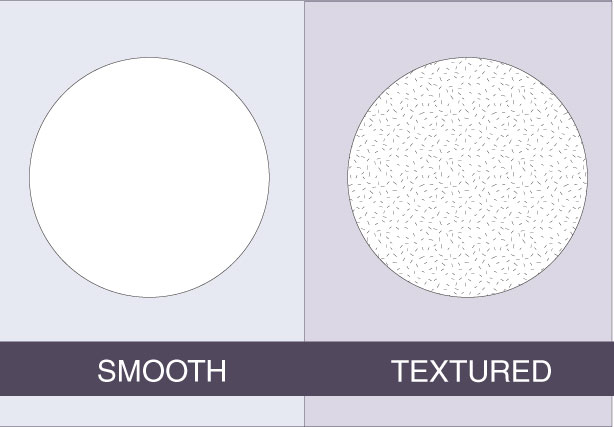
The implant shell can also feel different on the outside, which may or may not affect how the body heals around the implant. Some surgeons will only use smooth-surfaced implants, while others swear by "textured" implants.


The plastic surgical literature doesn't really have much evidence to say that one is "better" than the other, not in hard numbers from clinical trials. So deciding "smooth vs textured" is generally up to the surgeon and you.
  • Is this stuff guaranteed?
Well, yes and no. Within a certain time frame, most implant manufacturers will replace implants at no cost if their labs determine that the cause of the implant "failure" is if there was something inherently faulty with the implant itself. Depending on the situation, your surgeon may also waive his/her fee. But that might still leave you responsible for any additional OR and anesthesia fees.

Generally speaking, though, if you wish you had gone bigger (or smaller) after the fact, you might be stuck with paying for the entire surgery all over again.


Other questions? Stay tuned for further Friday Figure Fix installments, or email me at angelinelimmd [at] duetplasticsurgery [dot] com.