Friday, June 18, 2010

Friday Figure Fix: Making them bigger, part 1

Photo courtesy of preciouskhyatt, flickr.com

Last week we answered a couple frequently wondered questions regarding boob jobs, or more clinically speaking, breast augmentation. Now let's tackle some more technical aspects of what it takes to make smaller breasts bigger.

Breast augmentation, is of course, surgery. This may seem self-explanatory, but I really can't emphasize this point enough. You shouldn't be able to walk into a doctor's office for the first time and on the same day walk out with bigger boobs. Cosmetic surgery though it is, breast augmentation still requires a careful history-taking and physical examination by a skilled surgeon long before anything goes up a cup size or two.

Questions (like these) should be asked and answered. Another key point is the placement of the incision or scar. There are several options these days, as you can see in my illustration below.


1. Transaxillary. This is the "armpit scar" - a small incision is made in one of the creases of the armpit, and a tunnel is made to the breast area to allow for placement of the implant. Sometimes a small video camera is used to help see the creation of the pocket where the implant will live; sometimes not.

Some patients and surgeons like this approach because it does not leave any scars on the breast. Instead, you have your scar in a fairly inconspicuous location (hopefully, no one's looking that closely in your armpits).

The downside of the transaxillary technique is that it is a remote approach to the breast; some surgeons feel that fine control over placement of the implant is not as precise. Also, if you need a revision for any reason after a transaxillary breast augmentation, it is very difficult to use the same incision - which means that you might end up with a scar on your breast anyway.

2. Periareolar. A lot of folks commonly refer to this incision as the one that "goes around the nipple", which isn't quite accurate. The incision is made skirting the underside of the areola, the pigmented area around the nipple. Many patients prefer this scar, because they think that it will be well hidden in that area of color change. Many surgeons prefer this approach because it offers direct access to the breast for the implant placement.

Personally, I'm not a big fan of the periareolar incision. I think that the scar is often more obvious when placed around the areola - it often heals to become either lighter or darker than the surrounding breast skin or the areola. Also, the border of the areola is very indistinct if you look at it closely. It's neither a straight line or perfect circle; our incisions are either lines or arcs, which makes it easy to spot from across the room.

One more downside to the periareolar incision: because you're cutting through breast tissue so close to the nipple, you run a slightly higher risk of interfering with sensation and breastfeeding potential.

3. Inframammary. This incision is hidden beneath the breast, just above the bra-line. Patients like it because a well-placed scar ensures that no one sees evidence of their surgery, unless they're peering underneath their breasts with a flashlight and magnifying glass. Surgeons like it because it offers great access to the space where the implants go.

Personally, the inframammary approach is my favorite, for the abovementioned reasons.

4. Transumbilical. This technique was developed and championed more recently, as plastic surgeons attempted to find a "more perfect" approach for breast augmentation. You may have seen it on those reality TV shows or marketed as the "TUBA" technique. The incision is placed in the belly button, which is a great place to hide scars. Unfortunately, you face similar limitations as the transaxillary technique and are tunneling implants quite a distance; this approach never lived up to expectations, and I don't know of any respected plastic surgeons who routinely perform breast augmentations this way.


Next week, we'll take a closer look at where those implants actually go. More questions? Email them to me at AngelineLimMD [at] DuetPlasticSurgery [dot] com.

Tuesday, June 8, 2010

Kind of a big deal...


Remember this? I was reminded of the whole "Math class is tough" Barbie debacle when I saw this piece by the New York Times' science columnist today, which revisits the hoopla over women in science spurred by comments from then-president of Harvard, Larry Summers.

I won't pretend to understand all of the obstacles and hardships endured by women who have fought their way to the top of academic math and science, but as a woman in surgery - and a female plastic surgeon, nonetheless - I can sympathize.

Let's face it, medicine used to be a boys' club. Growing up, my pediatrician was a lovely older man, and when the time came to choose a gynecologist, there were only men to choose from in my hometown.

But again, medicine used to be a boys' club. Now over half of all medical students are women, and the majority of pediatricians and OB/GYNs practicing today are women. In my surgical intern class at Stanford, six out of twenty-three of us were female, which was fairly impressive to me at that time.

The specialty of surgery, however, remains male-dominated. Why? Is it because men are better surgeons? I would have to disagree with that. Men tend to have bigger egos and greater hunger for power? As much as some may want to believe women are the fairer sex, no to that thought too.

Want to hear my personal theory (and that's all I claim for it - pure opinion, based only on my own experience and reality, no studies, no evidence to back it up)?

Surgery is tough. Any stubborn human being can put his or her head down, put the blinders on, and the nose to the grindstone for five, six, seven (or more) grueling years of residency. But women, as tough as we need to and can be, have an additional biological burden to bear; like it or not, our prime years are spent in surgical scrubs, sleeping in questionably clean beds in dingy call rooms, running around the hospital ward trying to answer to a dozen different bosses, staying on our clog-clad feet for marathon operations. A lot of women (and frankly, men, too) decide that this isn't worth it or that this life (temporary as it may be, if you can optimistically call five years temporary) isn't fair to their families.

I never thought about those harsh social and reproductive realities as a medical student trying to decide what kind of doctor to become. I liked surgery; I loved plastic surgery; and that was that. Maybe my naivete helped me endure. Being on the far side of those years, I can look back without regrets now.

Those years are exactly what make me unique; there aren't that many female plastic surgeons out there (kudos to Stanford for being at the forefront of training women in plastic surgery; perhaps a subject to explore in another post sometime).

And that is what makes my work relationship with Dr. Weintraub so special. Where else in the Peninsula/South Bay/San Jose area can you find a team of female plastic surgeons working together? That's right: Duet Plastic Surgery. We're kind of a big deal.

Friday, June 4, 2010

Friday Figure Fix: Sometimes bigger is better


In contrast to some of the previous topics handled here in the Friday Figure Fix, breasts (or as some might say more casually, boobs, bewbs, boobies, and my personal favorite, "the girls") elicit a stunning variety of feelings and opinions.

For example, if you have a tummy issue, I can pretty much guess that you have a little more tummy than you would like and you want it gone. Whereas with breasts, it could really be anything: too small, too big, too uneven, too droopy, a combination of any of these, or too much like a girl's (for my guy friends out there, you are not forgotten here at this plastic surgery blog!).

So let's tackle one breast-related Figure Fix at a time; we'll start with "too small".

Now before anyone out there gets too huffy, yes, breasts are beautiful (we discussed that last time), and yes, size is relative. But let's just imagine that you are a smart, well-adjusted woman who has always felt that she's a bit on the small side for her own figure or a smart, well-adjusted woman who used to be a little bigger (weight loss, pregnancy/nursing, etc) and misses them. You've tried it all: the rolled up sock or wad of tissues in the bra, the "chicken cutlet" gel inserts, the push-up/wonder/water/miracle bras. You've had a friend or two who had "her boobs done" and now you want to know the facts about breast augmentation as they pertain to you.

Lucky you, this blog has the answers to your questions coming right up.

Basics first...
  • Can anyone have breast augmentation?
Not exactly. Like I hinted at above, you have to be savvy enough to understand what you're undertaking when you sign the consent form for surgery. You also have to be of age to consent (sorry, all you hopeful 16-year-olds out there, you're just going to have to wait). And, at least for me, you have to be a reasonable person with reasonable expectations.

Of course, if you look around hard enough, you'll find someone who's willing to be a bit more lax in their regard and restrictions. But is that what you really want in your surgeon, someone who prefers the fuzzy side of ethical?
  • Is a "boob job" real surgery?
Uh, yeah. By "real surgery", you mean it involves a knife and blood? Yes. There's no magic in making boobs bigger. There will be some pain and soreness afterward. Sorry.
  • Who should I see to have this surgery done?
If it were me, I would look for a couple key qualifications: 1) a surgeon, 2) a plastic and reconstructive surgeon.

Generally speaking (and there are always exceptions), plastic surgeons who have completed 5-7 years of specialized surgical training are well qualified to perform breast augmentation (versus other doctors or medical professionals, who may not even be surgeons but claim competence after completing a weekend-type course).

See also answer to question #1, last sentence of second paragraph.
  • What exactly are these implants that are going to be stuffed into my chest?
All breast implants approved for use in the United States today are made of the same silicone shell; the major difference that's discussed is what fills those shells. They can be filled with saline (salt water solution, similar to the balance of fluid already in your body) or silicone gel (a squishier non-native substance, whose appearance helped earn the nickname, the "gummy bear"implant).


Photos courtesy of allergan.com


One's saline-filled, the other's silicone-gel filled. Can you tell the difference? Yeah, not so much by looking at a picture - but feeling the implants gives you the obvious answer. The saline-filled one is pretty similar to a water balloon, whereas the silicone-gel filled one is like one of those stress reliever balls you squeeze in your fist. Some say the silicone-gel filled implant mimics the consistency of the human breast more closely.

There are also other, more minor differences in implants. The shape of the implant can be round or what is termed "anatomic".

As you can see in my lovely illustration, the implants when viewed flat on from above look fairly similar in shape (round, or close to round). When the implants are placed on a flat surface and viewed from the side, you can see more of a difference. But when you hold up the implants as if in the position they will assume in an upright woman, the difference between the round and "anatomic" implants are fairly negligible - both resemble the natural breast pretty closely, due to gravity.

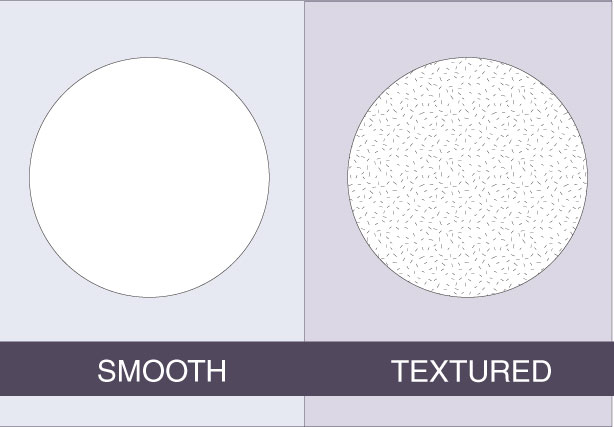
The implant shell can also feel different on the outside, which may or may not affect how the body heals around the implant. Some surgeons will only use smooth-surfaced implants, while others swear by "textured" implants.


The plastic surgical literature doesn't really have much evidence to say that one is "better" than the other, not in hard numbers from clinical trials. So deciding "smooth vs textured" is generally up to the surgeon and you.
  • Is this stuff guaranteed?
Well, yes and no. Within a certain time frame, most implant manufacturers will replace implants at no cost if their labs determine that the cause of the implant "failure" is if there was something inherently faulty with the implant itself. Depending on the situation, your surgeon may also waive his/her fee. But that might still leave you responsible for any additional OR and anesthesia fees.

Generally speaking, though, if you wish you had gone bigger (or smaller) after the fact, you might be stuck with paying for the entire surgery all over again.


Other questions? Stay tuned for further Friday Figure Fix installments, or email me at angelinelimmd [at] duetplasticsurgery [dot] com.

Saturday, May 29, 2010

Just for men: the latest in faking it

From the Sculptees website

Sometimes this blog can seem overly female-centric; but come on, I'm a female plastic surgeon. This blog is about plastic surgery, and the vast majority of plastic surgery patients are women.

But guys, this post is for you. We first heard about these innovative man-garments a little while back, but the NY Times Style section is hitting it up again.

Enjoy your Memorial Day weekend without fear!

Friday, May 28, 2010

Friday Figure Fix: Boobs, boobs, boobs!

Photo courtesy of m_bartosch

Momentous day here:
  1. Finally, a long-promised Friday Figure Fix post! And you thought I was just stringing you along.
  2. According to Google, this is my 100th post. Amazing.

So, as you can tell from the title of this entry, there's nothing subtle about the subject matter. Everyone loves boobs, right?

Forgive my cavalier attitude, but as a female plastic surgeon who takes the matter very seriously and personally, sometimes you need to lighten things up a bit.

In previous Friday Figure Fix posts, we've covered just about every other major body part and "flaw", and now with Memorial Day Weekend fast on our heels, we can almost call it summer. You already know how to deal with the other anxiety-inducing bits unveiled by bikini season, now we have to face "the girls".

Breasts are remarkable appendages. We're mammals, so we've all got them, both men and women. In women, of course, the parts tend to be a little better developed - mammary glands, which serve an incredible function - producing milk for little ones. And of course, there is the aesthetic and sexual function of breasts.

Some women feel that their breasts are too small for their frame; others find that they are burdened by overly large breasts - headaches, neck and back pain, shoulder grooving from bra straps, skin irritation and rashes. And nearly every woman has been frustrated by the impossibility of finding a proper fitting bra.

Some women (and men, too) are born without a breast; others are forced by the diagnosis of cancer to have one or both removed.

Over a lifetime, breasts undergo quite a few changes; there is the joy of puberty, cyclical variations with menstruation, ups and downs with weight oscillations, growth during pregnancy, explosive engorgement with nursing, the stretch marks, droopiness, and deflation following child rearing, and the inevitable pull of gravity with aging.

Regardless of what you were born with, there is beauty within. Even after a lifetime of changes, many women are wholly appreciative of what they have; they have their fans as well.

But many women miss what they had before - or what they never had; besides, this is a plastic surgery blog, so we're going to discuss what to do with those boobs in the next few Friday Figure Fix posts.

Friday, May 21, 2010

Friday...

And you loyal followers thought maybe, just maybe, there would be another installment today... No such luck in the MPL world. It's not over yet, though, I promise. I have more facts, thoughts, and wild opinions to share with all of you, don't you worry...

Wednesday, May 19, 2010

A My Plastics Life Public Service Announcement

When I saw this article in the NY Times yesterday, it made me think of the presentation I give for the HealthTrust of Santa Clara to eager high school students about what I do as a plastic surgeon.

Sure, my life in plastic surgery is all about boobs and Botox - or some would think... I use the class period to reveal a little bit more about the wide, wonderful world of plastic and reconstructive surgery. The NY Times article talks a bit about the spills that professional cyclists endure, and part of my presentation describes dealing with the medical consequences of those accidents. In a few words: lots of stitches, metal plates and screws.

So the one thing I beg the students to remember from my talk? If you ride a bicycle, you need to wear a helmet. I can save your face, but first, the helmet has to save your life.

One student complained, But I had a friend who was wearing a helmet when he got into an accident, and the stupid thing cracked!

Exactly. Better the helmet than your head.